by Spindlewood | May 27, 2022 | Uncategorised

What type of wood is used for a wooden handrail?
A banister is a long piece of support that runs beside stairwells. In terms of terminology, handrails and banisters are interchangeable. A stair railing, on the other hand, is intended to keep you from falling down the stairs. Oak and pine are two of the most common varieties of wooden handrails, and they are at opposite extremes of the pricing and durability spectrum. Oak is a more expensive timber due to its strong durability. Pine is a softwood that is less durable but far less expensive. Maple is another hardwood that is used for the wooden handrail on a staircase due to its aesthetics and high quality finish. Ensuring that your chosen material is strong enough to handle weight should be your highest concern. Having a hardwood handrail is advisable for those that require a lot of support from the handrail when they are using the stairs.
You should think about the color of the house’s siding and trim. Continue the appearance with your deck board and handrail colour choices if the siding and trim are complementary. Match your trim and handrail colours for a totally seamless look. Use a contrasting or darker handrail colour if your trim and siding colours are more dramatic. If you’re merely painting the railing, go with a neutral color that complements the treads, spindles, and uprights (black or dark brown, for example). Consider a black and white color scheme if you’re painting the entire stairway. Choosing the same colour and material as the doors in your hallway is a good idea if this is a viable option.
If you’re looking to install a wooden railing outside in your garden, Teak is one of the most popular woods for outdoor furniture and is regarded by some to be the best. It’s waterproof, long-lasting, and UV-resistant. It’s also a beautiful wood to look at. It’s resistant to insects and does not collect dirt. Cedar and Oak are also two very popular choices for decking and railings outside. The wood must be pressure treated to help prevent it from being affected by the outdoor elements. They may require oil or polish to help maintain their colour and quality.
How do you make wooden handrails for a staircase?
The most important step to take is measuring the area you wish to have a wood stair handrail installed. For staircases, you need to decide on what style of handrail you wish to have running up along the stairs. Will it be supported by a wall or spindles? The thickness of the wood needs to be thick enough to ensure the material doesn’t break if too much weight is applied. Having the right tools to complete the job is essential. You’ll need more than a screwdriver. If you’re buying wood to make the handrails, you will need saws, sanders, paint, varnish and polish. Creating a wooden balustrade rail is much harder than using a metal handrail bracket and supports for a running handrail supported on the wall. Opting to buy a primed versatile wooden balustrade which can work for almost any staircase will save you a great deal of time and labor. You can buy additional accessories such as newel posts and caps for the top and bottom of the stairs to create a clean cut look to your handrails. Make sure to apply paint to your stair handrails before you install them as this will save a great deal of time and prevent any unwanted mess.
Spindlewood Specialist Woodturning has a variety of railing profiles for you to view and choose from. Their profiles are architecturally correct and would work well in most stair renovations. The handrails can be customized to fit a number of spindle sizes and are available in a choice of woods. Each product is made to fit and is designed in line with the requirements from the customer.
How much is a wooden handrail?
If you choose to make a handrail out of wood, maple or oak are more durable choices. Although more expensive than softer timbers, these hardwoods are more durable. Aside from affordability, they also provide a style that is appealing to particular design aesthetics, such as traditional. Having a custom made versatile timber balustrade will cost more, however you will be able to choose the wood and design to fit in with your home perfectly. The choice of material and length of the rail will be the deciding factor on how much you pay.
Get in touch with Spindlewood Specialist Woodturning for more information. You can view some examples of the type of handrail they have created for individual customers.
Can I get an oak handrail made?
Getting a handrail made from oak is a lot easier than you may have thought. Having an oak rail to match a door or flooring compliments the aesthetics of the room and looks fantastic. Whether it’s mounted on a wall or upright on posts, Spindlewood Specialist Woodturning are here to create the perfect handrail for your home. With an engineered construction finish, their designs come ready and primed to be installed. Available in oak and other timbers, they can assist in helping create a design that works and looks great. A small handrail made from oak can also be made for the bathroom for those with mobility issues.
Can glass be used with a stair handrail?
Glass is by far the most popular material for modern railing. Glass railing creates a striking visual impact, enhances openness, expands areas, and allows light to flow freely. Along with metal, together they can make for a striking impression. Metal interior railings are typically made of iron, steel, or powder-coated aluminum and are an inexpensive way to add some style. They’re sturdy and fashionable, easy to maintain, and won’t cost you a fortune as a homeowner. Tempered (toughened) laminated glass with a minimum thickness of 21,5 mm or 27/32 inches is the best type of glass for staircases. Both steps and railings or balustrades are made of this sort of glass. This is the safest form of stair glass available.
by Spindlewood | Mar 17, 2022 | Wood turning
Our Woodturning Workshop
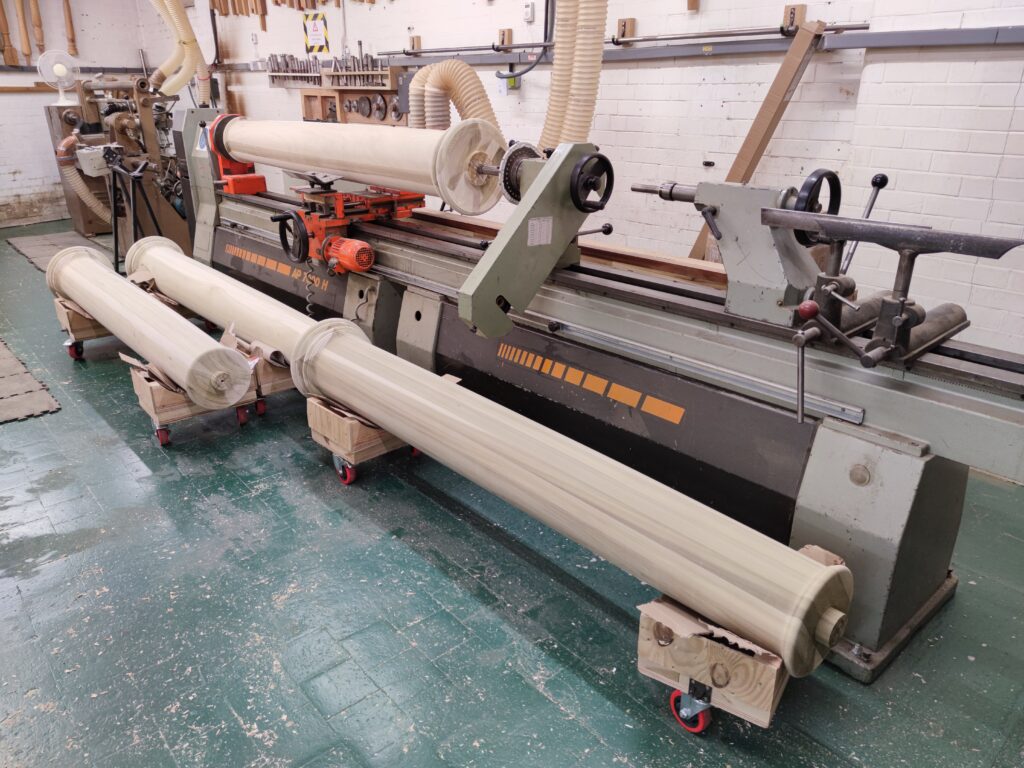
Spindlewood Wood Turning are woodworkers who specialise in Wood Turning from our specialist woodturning workshop located in somerset. It is from here that Spindlewood supplies high-quality wood tuning for architects, project managers, builders’ furniture restorers, and homeowners all over Europe and the USA.
The Woodworking Workshop
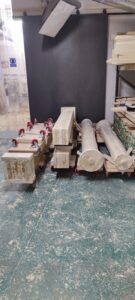
The fully equipped workshop has been adapted to include dry storage to preserve the wood, oversized doors that allow us to produce larger items such as columns and masts. And a range of equipment and machinery that allows us to adapt our skills to a wide variety of requirements.
Our woodturning workshop machinery includes:
- Copy lathes, grinder and buffer
- Barley twist machines
- Rod milling machines
- Routers
- Sanders
- Dowl milling
- Fence Post Rounding Machine
- Cross Cutting
In fact, our lathes are capable of turning columns up to 6 meters in length. Very few wood-turning workshops have the capability to produce large columns of this size.
Workshop Workflow
We have set out the Spindlewood workshop to follow the path a piece of wood may typically follow from reception to despatch. To ensure we are efficient in the component production. Wood is received and held in dry storage before moving to production, finishing, quality control and dispatch.
Tools Layout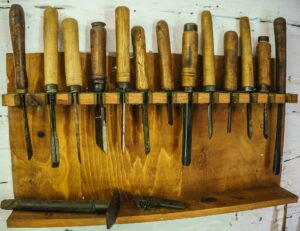
Our Tools are laid out as we would generally use them in succession, they are generally close to each other to minimize movement. For example, we have grouped the jointer/planer/table saw as these are often used in the milling process repeatedly and restrict the amount of time needed to move between tools. We store each cutting tool such as chisels, close to the station they are most used at such as the lathes and workbenches.
Natural Light
We place our most used areas closest to natural light, close to the windows as not only does it give us an abundance of light we also enjoy the view.
Flexibility
No matter how much planning we put into the layout of the wood-turning workshop, from time to time we are awarded a commission that simply does not follow our workshop layout and we need to move components to accommodate the design and execution of the pieces. Where possible we have incorporated the ability for our machines to be moved around to accommodate the flexibility required to fulfill our customer’s commissions.
Electrical Outlets, plug sockets are each raised to be around 1.25 meters above the floor, they are above the height of the workbenches and make it easier to plug in small tools as and when required without causing the impact damage if they were located closer to the floor.
Ventilation & Dust
Dust collection is becoming increasingly important throughout the workshop. Dust particles created when the wood is turned, machined, or cut can be a contributing factor in breathing difficulties it is also a fire risk when left to settle. We take precautions to prevent and minimize the risk of harm and fire. We have a strict policy of ensuring our extraction facilities are always working when the wood is being machined, this will remove airborne dust particles from within the workshop, staff are required to wear safety equipment, face coverings to prevent breathing difficulties later in life, protective eyewear, gloves, and ear protection. We have also adopted a strict cleaning regime that ensures a comprehensive daily, weekly and monthly cleaning policy is in place to ensure health and risks are adequately addressed.
In this article, we have attempted to provide you with a broad description of how Spindlewood has laid out and invested in our Woodworkers Wood Turning Workshop. We are mindful that from time to time customers visit our premises and they are interested in how we undertake our work. We recognize that woodturning has progressed from a sector that was previously very highly skilled, and whilst those same skills still have value, much of the precision is now undertaken by our investments in quality machinery. However, this same equipment has to be maintained, programmed and managed whilst still adapting to the workflow of our workshop and the needs of our customers.
We sincerely hope that you have enjoyed this introduction to our Woodworkers Wood Turning Workshop, and we are blessed to be able to work in such a beautiful location with natural quality wood doing a job that both stretches our skills and rewards our efforts every single day.
Need to know more?
Contact Spindlewood Woodturning
Address: The Old Bakery 8 Edward Street, Bridgwater, Somerset TA6 5ET
Website: www.spindlewoodturning.co.uk
Email: info@spindlewoodturning.co.uk
Tel: 01278 453665
Opening Times
Monday 8:30am – 530pm
Tuesday 8:30am – 5:30pm
Wednesday 8:30am – 5:30pm
Thursday 8:30am – 5:30pm
Friday 8:30am – 3:00pm
Join Us on Social Media
Facebook
Instagram
Google My Business
by Spindlewood | Feb 16, 2022 | Projects, Wood turning
Wooden Staircase Spindles
According to Wikipedia, a Staircase spindle is:
“A spindle, in furniture, is a cylindrically symmetric shaft, usually made of wood. A spindle is usually made of a single piece of wood and typically has decoration (also axially symmetric) fashioned by hand or with a lathe.
Whereas Spindles are the vertical posts that connect the base rail and handrail on a staircase. Their primary purpose is safety, by stopping things falling through the gap between the base rail and the handrail.
Spindles are available in a variety of different styles and materials, usually wood,
What type of spindle to choose
Traditional wooden stair spindles make up the most decorative part of a staircase.
If you are selecting new spindles, you’ll need to ask yourself several questions to ensure you choose the right pieces for the job.
- Is your staircase closed string or cut string?
- Are the spindles all the same size?
- Do you have a specific style (is the staircase new or an extension)
- How sturdy will the spindles need to be
Wooden Staircase Spindles
The most common material for staircase spindles in the home is typically wood. Wooden spindles have become a classic choice for staircases, other materials are available. Wood is usually, aesthetically pleasing, strong and durable and easy to maintain
For wooden spindles, there are a few options to choose from:
- Oak—a solid hardwood that will always make its mark
- Pine—can be easier to maintain and lower cost.
- Ash is a straight grained hardwood, predominantly light brown in colour
- Dark Hardwood, an ideal replacement for mahogany spindles
Wooden Staircase Spindle Styles
SQUARE TURNED SPINDLES
Originally square turned spindles and newels have been around since the late middle ages, however that technique became popular in the Edwardian era. Sadly due to the cost involved in producing these the style declined later in the 1930’s. We have developed a technique that means we can reproduce these styles at a reasonable cost.
CONTEMPORARY RANGE SPINDLES
Turned staircase components such as spindles, newel posts, newel caps and finials are a large part of our business. Our designs are architecturally accurate and cover a wide range of ages and styles. We also offer a matching service where we can reproduce an exact copy of an existing turning from the original or a drawing.
The examples shown below were recently designed by ourselves to accommodate and embelish modern interiors with a simple elegant touch.
FLUTED & TWISTED SPINDLES
 The origin of barley twisting and fluted turnings can be traced back to late antiquity as a mean of embellishing a turning. Barley twisting in particular was very popular in the 15th & 16th century and had a revival in the 18th & 19th century. Today we mainly do barley twisting, reeding and fluting on restoration projects and high end stair cases.
We can provide a comprehensive range of turned, barley twist or fluted spindles.Our designs are architecturally accurate and cover a wide range of ages and styles. Many examples are shown here.
We also offer a matching service where we can reproduce an exact copy of an existing turning from the original or a drawing.
Spindle spacing and building regulations
Spindles need to be properly spaced to achieve an even and consistent look and for building regulation purposes. Building regulations state that gaps between the spindles should not exceed 100mm. A domestic property can have a handrail height of 900mm for both stairs and landings. Commercial properties should be a minimum of 900mm on stairs and 1100mm on landings.
Why Spindlewood
Here at Spindlewood Woodturning we produce a huge range of custom furniture spindles, Staircase parts and handles turned parts. We offer a range of styles, woods and finishes professionally finished by time served, accredited and quality focussed professionals.
Need to know more about managing your woodturning restoration project, why not speak with an expert at Spindlewood.
Contact Spindlewood Woodturning
Address: The Old Bakery 8 Edward Street, Bridgwater, Somerset TA6 5ET
Website: www.spindlewoodturning.co.uk
Email: info@spindlewoodturning.co.uk
Tel: 01278 453665
Opening Times
Monday 8:30am – 530pm
Tuesday 8:30am – 5:30pm
Wednesday 8:30am – 5:30pm
Thursday 8:30am – 5:30pm
Friday 8:30am – 3:00pm
Join Us on Social Media
Facebook
Instagram
Google My Business
by Spindlewood | Jan 19, 2022 | Projects, Wood turning
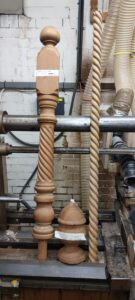 Here are some top tips for furniture restoration
Hobbyists, as well as professional furniture restorers, have one thing in common: The desire to find a piece of furniture that is damaged and then restore it back to its original and former glory. In this article we discuss furniture restoration.
Giving new life to an old item. A table that had broken legs and an uneven surface may have been the last thing it saw from its former owner. You see the possibility as a furniture restorer increased value, art, and design.
Restoring furniture means restoring an item’s original state. It’s often more than just giving the piece a makeover r a fresh coat of varnish or a distressed painted finish
Getting Started With Your furniture restoration Project
There are several Steps in your furniture restoration project
- Decide for whom you will be doing the work. – You, your family members, friends, or a commercial client.
- Create a design for the item – Do you want the item to be modern or contemporary?
- Decide upon a budget – Set your budget an stick to it, Determine how much and what kind of componants you will spend it on. Be clear about who, what kind of specialist assistance is needed and the specific tools and components that are required
- Decide who or what support you need – Do you need access to specialist skills, equipment of components, are these skills or components available.
- Describe the finish you are looking for – Are you looking for a lacquered or polished finish, distressed modern or contemporary.
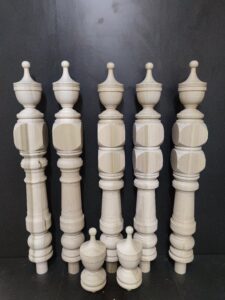 Design the Project
Each project starts with a beginning, a middle, then ends.
The beginning – Examine the furniture to determine which parts need attention. Which items will require the most time, and what can be done in-house? Request quotes and negotiate costs. You can purchase any material.
The Middle – Refer to your restoration plan and create drawings with the dimensions of items to be made.
Be sure to make time for the project It’s crucial to keep in mind that even a minor side project could quickly become a tedious chore depending on how skilled you are at restoration and how much time you have available to do the job.
Complex tasks take longer to complete. woodturning new table legs takes skill and precision, tools and a lathe. Make sure that you are able to spare enough time or resources to complete the project on time and within budget so that you can get a return on your investment.
It is not an easy task to redo slats or spindles. You will need to do extensive work to remove the dead or rotten wood. This is something that you must consider before you decide whether to take your table home.
Do your research and inspect
Before you decide to restore your item, do some research. Examine it carefully for any marks or labels which may be indicative of its provenance. Before you do any work, make sure to consult an expert if it is worth something. Photograph any tags or markings for your records. You could lose or reduce the value of a collectible antique by removing its finish.
Don’t be afraid to try your hand at furniture restoration. You can easily spot signs of aging. Feel underneath for dull interior corners. Take a part of a screw off and inspect the threads. The piece may be old if they are uneven in width. Take out a drawer to check for dovetail joints. These are signs that the furniture may be old or well-made. A professional appraiser should value it.
 Set up a budget
After you have determined the value of your treasure, decide how much money you are willing to spend on it. You might enjoy the challenges of furniture restoration. However, if it’s not valuable you will need to determine how significant the item is to your life. It is something you can repair relatively easily? Is the cost of this project less expensive than purchasing a brand new item? It is worth the effort? Sometimes it’s simply sentimental or the need to retain the style of the home
You may only need to make a couple of simple repairs that you are able to quickly finish some projects. Some projects may require more work and might end up costing more.
Know what you want it to look like
Every restorer has seen it happen: A wooden table is pulled off the curb thinking that its colour would match well with the other furniture. However, after restoration starts, the pieces are actually made of lighter wood. You can easily determine the grain’s true colour by examining it. You should look for a place that has been kept from daily wear such as the drawer’s back. A peek at an area that has not been used will help you visualize the final product.
Safety First
Even if your furniture is a masterpiece, you still need safety gear. You don’t want a piece of wood getting stuck in your eye, or causing you to breathe in harsh fumes.
To protect your skin against harmful chemicals in varnish and wood strippers, long sleeves are recommended. To protect your eyes, wear safety glasses. To keep strong vapors from escaping, use safety glasses and mask when you are stripping or varnishing. Always follow the health and safety instructions on the materials or equipment you use.
Furniture Repair
Repair or replace damaged parts. It is possible to find a similar knob or leg at an estate sale, antique shop, or do you need a woodturner to replace it. Professionals like Spindlewood have a matching service that may be helpful.
But don’t be discouraged. Most likely, custom-made parts will be required to match the perfect piece. If you are not a skilled craftsman, it may be necessary to hire a professional for more complex repairs, such as leg replacements, or anything related to the structure of the item.
Tightening the screws can fix wobbly chairs and tables. Turn the piece upside down and examine each leg at the junction with the body to find the problem. Check the screws if it moves. If the screws are in good condition, you can tighten them. Remove and replace any that are rusted. You can join small gaps with wood glue and then fill them with similar-colored wood pastey. Make sure to buy stainable wood putty if you intend on using stain for your finish.
The process of refinishing a piece involves removing the previous finish and creating a brand new one. This job is physically challenging, so you will need to put in some effort. Do-it-yourselfers can use both chemical strippers as well as sanding. Be patient even though certain finishes are difficult to get rid of. You could end up with more work if you try to hurry the process.
Find out what type of stain is best for wood. You can paint it if the wood is not worthy of staining. It doesn’t have to be valuable, but it will be no problem once it is painted. To smoothen any imperfections, you should sand them before painting. No matter if your intention is to stain or paint, it’s important to clean up the area after you have finished stripping.
Why Spindlewood
Here at Spindlewood Woodturning, we produce a huge range of custom furniture spindles, Staircase parts and handles turned parts. We offer a range of styles, woods and finishes professionally finished by time served, accredited and quality focussed professionals.
Need to know more about managing your woodturning restoration project, why not speak with an expert at Spindlewood.
Contact Spindlewood Woodturning
Address: The Old Bakery 8 Edward Street, Bridgwater, Somerset TA6 5ET
Website: www.spindlewoodturning.co.uk
Email: info@spindlewoodturning.co.uk
Tel: 01278 453665
Opening Times
Monday 8:30am – 530pm
Tuesday 8:30am – 5:30pm
Wednesday 8:30am – 5:30pm
Thursday 8:30am – 5:30pm
Friday 8:30am – 3:00pm
Join Us on Social Media
Facebook
Instagram
Google My Business
by Spindlewood | Dec 14, 2021 | Projects, Wood turning
Woodturning Projects From Spindlewood Turning
In this article, we look at some woodturning projects, for architects, builders, developers and property restoration specialists.
What are your most common woodturning Projects
We are often asked which are our most common woodturning projects, and whilst we accept woodturning projects from a wide range of sources and a wide selection of projects, from antique effect cannons to zoom masts or most common requests are for
- Staircase Parts
- Balusters and Porch Posts
- Furniture Turnings
- Columns & Large Turnings
In addition to these categories, Spindle Woodturning also undertakes specialist projects. We work with the whole spectrum of woods as raw material, including oak, mahogany, elm pine and most people recommend woodturning projects using Maple, Cherry, and Walnut. They are described as very stable and don’t tear out easily. They also give a great finish without a lot of difficulties.
What tools do you use for Woodturning Projects?
 Typically, lathes are used mainly in woodturning. Woodturning is the process of shaping wood into a chosen object. This is done so by using a variety of tools to shave, cut and groove the piece into the chosen shape or design. Due to the sheer amount of tools, you can use with your lathe, and the versatility of the tool itself – there are many objects that you can turn and create. We are amongst a handful of companies in the UK that have tools that enable us to turn columns up to 6m in length.
Using the correct tool or attachment for the correct job is vital and often comes with experience. We have all been there – either a chisel or an ordinary knife will slip out of its’ protective case and damage the wood or worse cause injury. Remember in every woodturning project – Safety first.
If you have a woodturning lathe, this isn’t something you’ll have to worry about replacing – as you can easily fix it yourself. It is possible to turn tool handles in a similar manner regardless of the length, with the only variable being the level of personalization you require.
Once you have drilled a hole in your naked tool, you can turn handles relatively easily.
Furniture Woodturning 
The costs of furniture can add up very quickly, especially if you want to keep them for a long time or if you want to pass furniture on down the generations.
Over time, the legs of both chairs and tables can become weak and break, resulting in furniture that breaks.
The good thing is that you can turn legs for both chairs and tables fairly easily and attach them quite easily once finished – but you will need additional hinges and screws (keep in mind the weight of the table and the material used when constructing the legs).
You can also modify existing chair and table legs with the many tool bits included with your lathe, and make them more visually appealing for visitors and family.
Why Spindlewood
Here at Spindlewood Woodturning, we produce a huge range of custom furniture spindles, Staircase parts and handles turned parts. We offer a range of styles, woods and finishes professionally finished by time served, accredited and quality focussed professionals.
Need to know more about managing your woodturning restoration project, why not speak with an expert at Spindlewood.
Contact Spindlewood Woodturning
Address: The Old Bakery 8 Edward Street, Bridgwater, Somerset TA6 5ET
Website: www.spindlewoodturning.co.uk
Email: info@spindlewoodturning.co.uk
Tel: 01278 453665
Opening Times
Monday 8:30am – 530pm
Tuesday 8:30am – 5:30pm
Wednesday 8:30am – 5:30pm
Thursday 8:30am – 5:30pm
Friday 8:30am – 3:00pm
Join Us on Social Media
Facebook
Instagram
Google My Business

Recent Comments